Introduction to Edible Insects in Circular Economies
The concept of a circular economy underscores the significance of minimizing waste and maximizing resource efficiency. In this transformative model of economic functionality, edible insects emerge as an innovative and promising frontier. They offer a sustainable and efficient nutritional source, allowing for a redefinition of resource utilization and waste management strategies.
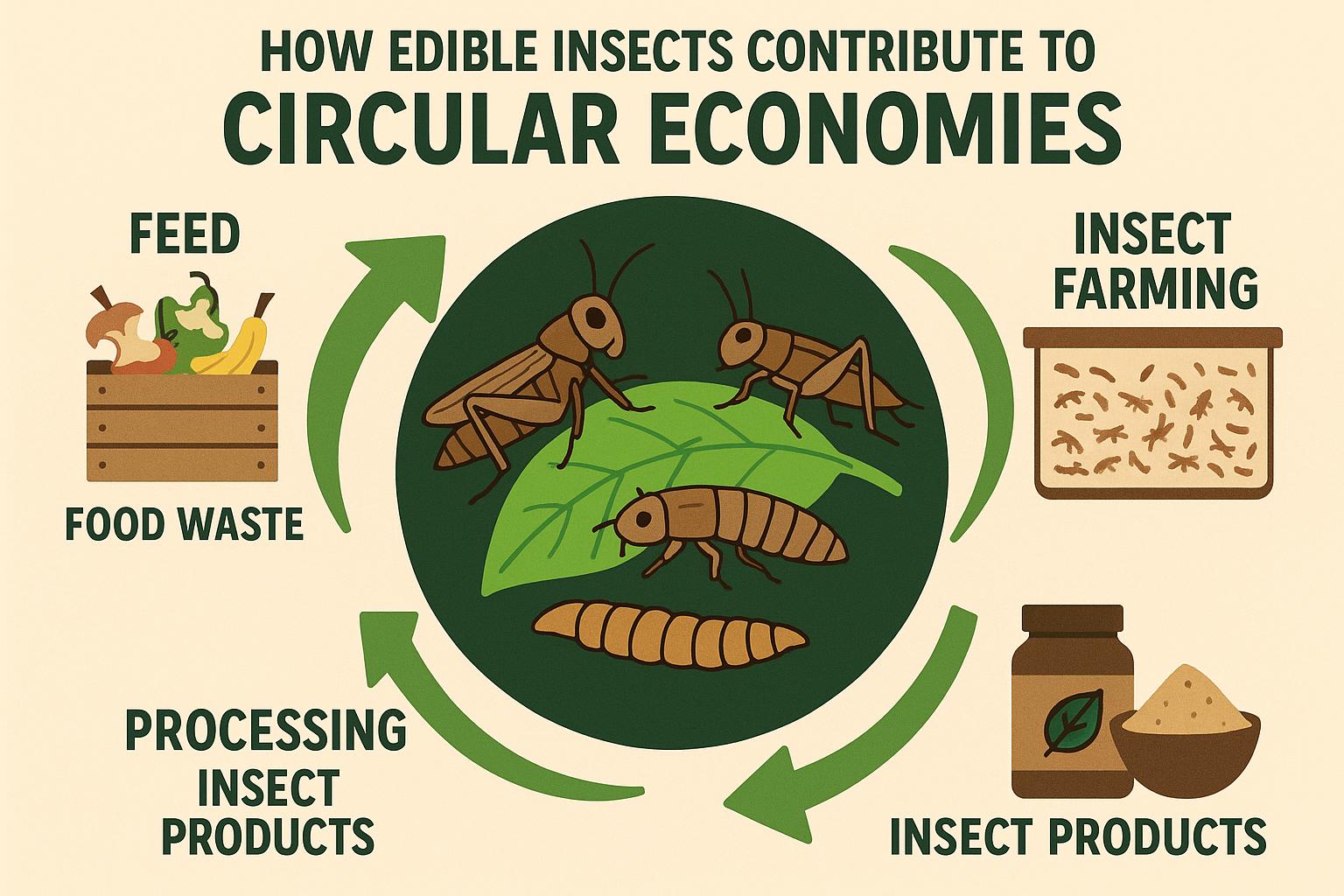
Circular economies advocate for a closed-loop system where resources are recycled, reused, and repurposed. Here, the potential of edible insects becomes particularly evident. With their ability to transform organic waste into valuable outputs, insects exemplify an elegant solution to the interlinked challenges of food security and environmental sustainability. By integrating edible insects into the food supply chain, there lies potential to create systems that are not only more resilient but also aligned with nature’s inherently cyclical processes.
Nutrient Recycling and Waste Reduction
Insect farming holds immense promise in the field of nutrient recycling and waste reduction. Insects such as mealworms, crickets, and black soldier fly larvae exhibit an extraordinary ability to consume organic waste materials, including agricultural byproducts and food scraps. This capability converts otherwise wasted resources into high-quality insect protein and organic fertilizers.
This natural conversion process is not just beneficial but also essential. By diverting organic waste away from landfills, the risk of methane production—a potent greenhouse gas—is significantly reduced. Methane emissions from decomposing organic matter in landfills are a considerable environmental concern, and insects provide a biological solution to curtailing this issue.
Moreover, the protein-rich food produced through insect farming can supplement both human and animal diets. This transformative approach can lessen the dependence on crop-based animal feeds, thus decreasing the competition for agricultural resources. Consequently, the integration of insects into agricultural systems provides a symbiotic relationship that aligns synergistically with circular economy principles.
Resource Efficiency
Insects are unparalleled in their resource efficiency. Compared to traditional livestock such as cattle, pigs, and poultry, insects require substantially less land, water, and feed resources. According to the Food and Agriculture Organization, the feed conversion efficiency of insects far surpasses that of more conventional livestock. This efficiency is largely because insects are cold-blooded, enabling them to convert a greater proportion of their food into body mass rather than maintaining body heat.
In a world where natural resources are becoming increasingly scarce, this high feed conversion rate is crucial. Insects can thrive on organic waste products or byproducts that are non-competitive with resources needed for direct human consumption. This means that even in terms of feed input, insects embody the concept of “waste not, want not,” which is a cornerstone of the circular economy model.
Furthermore, considering the small ecological footprint of insect farming, adopting this practice can yield considerable reductions in environmental resource burdens. For example, the water use for insect farming is remarkably low compared to what is needed for cattle and other livestock, making it an attractive option in water-scarce regions around the world.
Reducing Environmental Impacts
The incorporation of insects into modern food systems stands to lower environmental impacts significantly. Traditional livestock farming practices contribute substantially to methane and carbon dioxide emissions, exacerbating climate change challenges. Insect farming, by contrast, results in minimal greenhouse gas emissions, thus providing a more environmentally friendly alternative.
Moreover, insect rearing is designed to minimize waste production. Virtually every part of the insect can be utilized—whether as food, feed, or for other secondary purposes—thereby reducing what is traditionally considered waste in other farming systems. This comprehensive utilization model supports the goal of minimizing ecological footprints and enhancing sustainability across food production systems.
An additional facet of environmental benefit includes the use of insects in bioremediation. Some insects have been integral in the breakdown and detoxification of pollutants in soil, another layer of potential that aligns with global environmental restoration efforts.
Conclusion and Future Prospects
As the global population trajectory continues to ascend, identifying sustainable food sources becomes increasingly urgent. Edible insects offer a practical and innovative solution, closely aligned with circular economy principles. Their benefits span efficient resource utilization, waste reduction, and nutrient cycling—key dynamics in designing sustainable and resilient future food systems.
Realizing the full potential of insects within global economies entails a concerted effort in research and development. Innovations in insect farming technology, regulatory framework advancements, and public perception shifts are critical components that will influence the scalability and efficacy of this promising food source. Continued investment in these areas will both illuminate and fulfill the role edible insects can play in advancing global sustainability goals.
The inevitable challenges in consumer acceptance, infrastructure development, and policy creation present opportunities for innovation and collaboration across various sectors. Education and awareness programs may bridge the gap between current perceptions and the sustainable future that embraces insects as a mainstream food source.
Hence, incorporating edible insects into the fabric of a circular economy does not merely address the issue of sustainable food production; it inspires an entire re-evaluation of how society considers, interacts with, and benefits from natural resources. As these initiatives progress, the integration of insects into food systems will undoubtedly play a pivotal role in rolling out a sustainable roadmap that aligns with the environmental, economic, and social dimensions of a circular economy.